
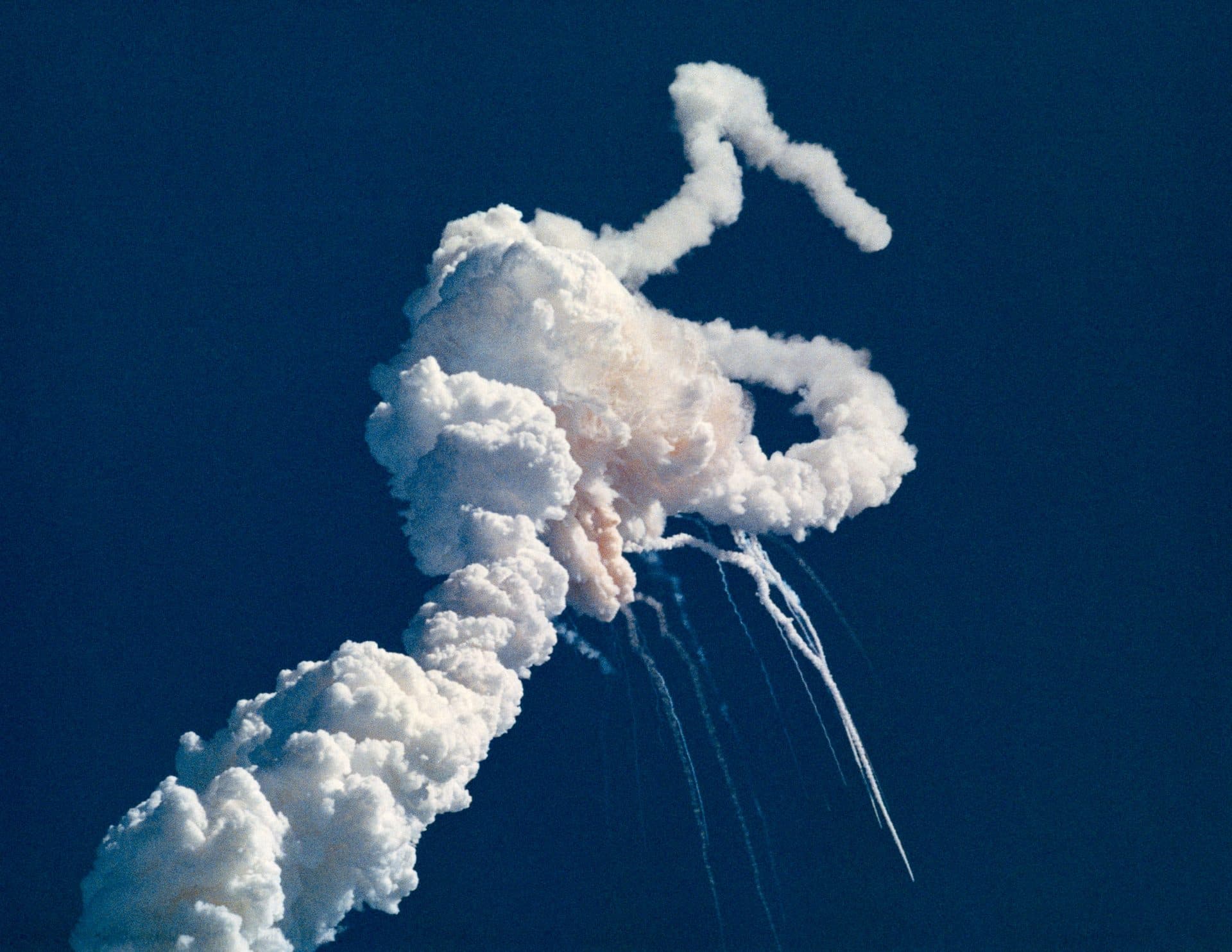
Incident Review #2. Space Shuttle Challenger, January 28 1986.
The night before Challenger launched, the people who were right were in the room. They had the data. They had charts. They made a formal recommendation not to fly. And they lost.
That is the part of this accident that should unsettle anyone who has ever been in the room when a high-stakes call had to be made. We tend to file Challenger under they didn't know — a cold-rubber surprise, a gap in the data. The opposite is true. The risk was named out loud, in writing, by the engineers closest to the hardware, hours before ignition. The launch went ahead anyway. Understanding how requires looking past the cold O-ring to a single move in the decision itself: the question on the table got turned around, and once it was turned around the right answer could no longer win.
The published investigation below holds the whole picture — the hardware, the review history, and the management decision, as three parallel chains. This review walks the third one: how a documented engineering objection became a launch approval in the space of one evening, using only the public record, primarily the 1986 Rogers Commission report and the analysis that followed it.
The room, the night before
By the evening of January 27, the forecast for the morning launch was record cold — far below anything in the flight history. The booster's field-joint seals had never been flown that cold. To the engineers at the booster contractor, that was disqualifying: the seals had to flex into a moving gap at ignition within milliseconds, and cold rubber is slower and stiffer. They had watched joint temperature track against seal damage on earlier flights, and the trend pointed the wrong way.
So on a teleconference that night they did exactly what a hold point is supposed to make easy. They presented their charts and made a formal recommendation: do not launch below the coldest temperature at which the joint had ever flown. It was a clear, documented, engineering no-go, raised before the decision was made, by the people who owned the analysis.
That should have been the end of it. A recommendation like that, at that moment, is the entire reason a flight-readiness process exists.
The sentence that flipped the question
What happened instead was subtle enough that it can pass unnoticed in the transcript, which is exactly why it is worth naming. The government program managers on the call pushed back hard — and in pushing back, they changed the question.
The engineers had come to answer is it safe to fly this cold? The reply they got, in effect, was prove that it isn't. The burden of proof inverted. Instead of the launch having to clear the objection, the objection now had to prove a catastrophe in advance. During a private side meeting, a manager at the contractor was told to take off his engineering hat and put on his management hat. Management reversed the recommendation to a go. The engineers who had dissented were not asked to sign the new rationale, and their reservations never traveled up to the people making the final launch decision.
No rule was broken in any visible way. A concern was raised, discussed, and "resolved." On paper the process ran.
But the thing that actually decided the launch was not the data — it was the direction the burden of proof was pointing.
Why no one could clear that bar
Here is why the inversion was fatal rather than merely unfair: prove it will fail is a bar that almost nothing can clear.
You cannot prove, in advance, that a specific flight will end in catastrophe. Failure is probabilistic; the engineers could show the risk was high and climbing, but they could not produce a guarantee. The moment the question became "show me it will fail," the objection was guaranteed to lose, no matter how strong the underlying case — because certainty of failure is not a thing engineering can hand you the night before a launch.
That is the trap. A hold point only works if clearing it requires positive evidence of safety. Flip the burden, and the absence of a guaranteed disaster reads as permission. The people in the room were not reckless and were not stupid; several of them believed they were making a reasonable call. They were answering a question that had quietly been rigged so that "proceed" was the only available answer.
Every quality professional has seen a smaller version of this on a Friday afternoon. A hold gets raised, nobody can produce an ironclad proof of harm, schedule leans on the room, and the working rule slides from demonstrate it's safe to demonstrate it's dangerous. Same inversion, lower stakes. The control is still there in the procedure. It has simply stopped doing anything.
Why the flip held — the structure behind it
A flipped question should be easy to flip back. Someone in the room says wait — the right question is whether we've shown this is safe, and we haven't. On this call, no one with the authority to do that was positioned to.
The reason is structural, and it is the most transferable part of the story. The same program office that owned the launch schedule also sat in judgment of the safety concern.
The people most exposed to the cost of a delay were the people deciding whether the delay was warranted.
There was no independent safety authority in the loop — no one whose job was to protect the hold and who did not also answer for the calendar. When the office under schedule pressure also holds the veto, the burden of proof doesn't just flip occasionally; it flips reliably, in the direction of flying.
This is not unique to a launch pad. It is the auditor who reports to the plant manager, the quality sign-off that rolls up to the production lead, the change-approval board staffed by the team that owns the ship date. Independence is not an organizational nicety. It is the thing that keeps the question pointed the right way when the schedule starts to press.
Why the room felt so sure — the oversold margin
There is one more layer, and it explains why the managers pushing back did not feel like they were gambling.
They were working from a belief about the odds that the engineers did not share. Leadership's own reliability estimate put the chance of a catastrophic failure at something like 1 in 100,000 flights. The working engineers, building up from how the components actually behaved, put it closer to 1 in 100 — a thousandfold gap. In his appendix to the Commission report, Richard Feynman concluded the optimistic figure had essentially been chosen from the top down: a number compatible with the flight rate and the budget the program needed, then defended, rather than a number derived from the hardware.
That gap is why the inversion felt safe to the people who performed it. If you genuinely believe the margin is 100,000 to 1, then demanding proof of failure feels almost reasonable — surely this isn't the one. If you believe it is 100 to 1, the same demand is recklessness. The two camps were not weighing the same risk; they were weighing different numbers, and the number that won was the one that fit the schedule, not the one built from the parts.
When the optimistic estimate and the schedule point the same way, and there is no independent body to reconcile the engineering number against the management number, the comfortable figure wins by default. The belief that "this is fine" was not a lapse of attention. It was manufactured upstream, and it made the fatal question feel like a formality.
Catching the inversion in your own go/no-go
The cold rubber is what failed at ignition. The inverted question is what failed the night before, and it is the part that travels. Hardware faults are specific; a decision rule that flips under pressure is general, and a version of it is waiting wherever people make hard calls under pressure.
Three things keep the question pointed the right way:
- A hold clears on affirmative evidence of safety — never on the absence of proof of harm. Write it down that way. "We couldn't show it would fail" is not a clearance; it is a hold that hasn't been cleared. If the only argument for proceeding is that no one produced a guaranteed disaster, the burden has already flipped.
- The authority that can clear the hold cannot be the authority that owns the schedule. Whoever protects the hold must not also answer for the ship date. Without that separation, the inversion is not a risk — it is the expected outcome.
- The numbers behind "it's probably fine" have to be built from the parts, not chosen to fit the plan. When a confidence figure and a deadline happen to agree, ask who derived the figure and from what. A reassuring number with no bottom-up basis is not evidence; it is the schedule wearing a lab coat.
None of this would have required new technology in 1986. It would have required the question in the room to stay show me it's safe to fly this cold — and a person, independent of the launch schedule, with the standing to insist on it. The seal failed because it was too cold. The launch was approved because the hardest question of the night got turned around, and no one was positioned to turn it back.
If you own a go/no-go anywhere — a release gate, a batch disposition, a change-approval call — the question worth carrying out of this one is simple: on our last few close calls, were we proving things safe, or just failing to prove them dangerous? The honest answer tells you which way your burden of proof is already pointing.
This post works through one lens of a 3-legged 5-Whys investigation — the Systemic leg. For a full explainer of all three legs with worked examples, see What is a 3-legged 5-Whys? (with examples).
Sources: Report of the Presidential Commission on the Space Shuttle Challenger Accident (the Rogers Commission report, 1986) — Volume 1, Chapters IV–VI on the seal failure, the pre-launch decision, and the accident's history, and Richard Feynman's Appendix F on reliability; Diane Vaughan, The Challenger Launch Decision (University of Chicago Press, 1996). Where this post characterizes the pre-launch teleconference, it follows the Commission's published findings; it describes roles rather than naming individuals.