
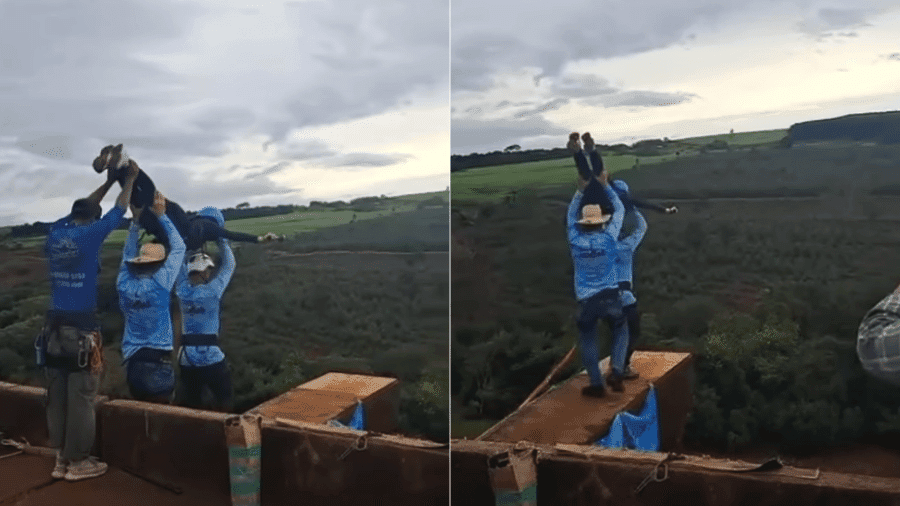
Incident Review #3. Ponte do Esqueleto, Limeira/Cordeirópolis, São Paulo, June 13 2026.
On the morning of June 13, 2026, Maria Eduarda Rodrigues de Freitas, 21, was launched from the Ponte do Esqueleto — the "Skeleton Bridge" — during an unauthorized rope-jump event. Her safety rope was still coiled on the platform. She fell roughly 40 meters and died at the scene. Three instructors were later arrested and charged with homicide.
The footage is harrowing, and the immediate cause is almost too simple to believe: the rope was not attached. News coverage rightly focused on the victim, the arrests, and the shock of the video. But for a quality or safety professional, the important question is not what the instructors failed to do in the final seconds. It is why a high-risk activity was able to operate at that location for years, after earlier warnings, with no enforceable safety regime.
That is the difference between a headline and an investigation. This post walks the Ponte do Esqueleto event as a 3-legged 5-Whys — Occurrence, Detection, and Systemic — using only public sources. The interactive map below is the same tree, built in RCA Map.
Leg 1 — Occurrence: the final check failed
The proximal mechanism is straightforward. Two instructors lifted the participant and a third initiated the launch. The safety rope, which should have been secured to her harness, was not connected. It remained on the platform. Once she was in the air, there was nothing to arrest the fall.
This is the layer most coverage stopped at, and it is the natural starting point for any investigation. But if we stop here, the only corrective action is "be more careful" — which is not a control. Arresting the individuals addresses accountability; it does not close the class of failure. A CAPA-grade investigation has to ask why the check that should have caught this was not load-bearing enough to prevent the launch.
Leg 2 — Detection: the warnings were already there
Almost no serious event is a true surprise. In this case, the signals were public before June 13.
According to reports that surfaced after the fatality, a nine-year-old child had been injured in a jump with the same team roughly three months earlier. The incident reportedly involved the support rope being released before the jump was complete. It did not result in a death, so it did not trigger a shutdown or a regulatory response. It became a near-miss that stayed near-miss-shaped until the next event.
Separately, the Secretaria do Patrimônio da União (SPU), the federal agency that owns the bridge, had requested access restrictions since 2024, following a fatal cyclist accident at the same site. The municipality of Limeira, meanwhile, had taken administrative measures in early 2025 and was pressing federal authorities for action. The structure sat between two municipalities — Limeira and Cordeirópolis — and on federal property, which made every level of government a partial stakeholder and no level the clear owner.
That is the Detection leg in plain terms: the event was preceded by a prior injury with the same operator, a prior fatality at the same location, and documented requests for physical access control. None of those signals were configured to stop the activity. A detection system does not exist until a signal forces a response. Here, the signals were visible but not wired to a halt.
Leg 3 — Systemic: the jurisdiction gap
The bridge was built in the 1990s for a railway line that was never completed. After the railway project collapsed, the structure became federal property. It sits in a rural area, adjacent to private land, near a highway. It was never designed as a recreational facility, and the SPU stated publicly that it had never authorized any activity there.
Yet rope-jump events operated at the site for years. Rope Trips listed events at Ponte do Esqueleto from at least May 2025 through March 2026, and the landowner later told G1 that unauthorized extreme-sports use had been happening since around 2020. The reason this was possible is not mysterious: the bridge had no active use, no on-site steward, and no single authority responsible for keeping people off it. The municipality said safety was a federal responsibility. The federal agency said it had asked the municipality for help blocking access. The result was a contested, under-maintained asset that functioned as an unregulated adventure-sports venue by default.
Brazilian adventure tourism is not unregulated in principle. ABNT technical norms and the Lei Geral do Turismo set requirements for activities like rope jump, and trade bodies such as ABETA publish safety guidance. But enforcement depends on licensing, inspection, and venue control. When the venue itself has no clear owner, the enforcement chain has no place to attach.
That is the systemic root: a hazardous, federally owned structure with no operational purpose, no steward, and no inter-agency agreement for access control became a de facto commercial venue. The instructors made the final error, but the system had already decided that no one would stop them.
The generalizable lesson
There is a pattern here that translates directly to manufacturing, construction, energy, and medical devices: an operator error becomes fatal when it occurs in a space where the normal controls are missing.
Most incident reviews will find the operator error. Many will find the prior near-miss. Fewer will trace the failure all the way to the ownership structure that left the hazard uncontrolled. That last step is where preventive actions stop being about individuals and start being about the system.
Consider how often a similar shape appears inside a plant or facility:
- A contractor performs work on equipment that is technically owned by another department.
- A temporary line runs for months because the formal project is delayed.
- A warning sign is reported, but the area is "not our scope."
In each case, the immediate failure looks like a person making a mistake. The systemic failure is the boundary that let the mistake reach the consequence.
What a 3-legged 5-Whys catches that a timeline misses
A timeline of June 13 would record: participant arrives, harness is fitted, rope is not attached, launch happens, fall happens, emergency services respond, instructors are arrested. That is accurate and incomplete.
The 3-legged structure forces three questions that a timeline does not:
-
What physically failed? The rope was not connected. This produces the immediate corrective action: a mandatory two-person check before any launch.
-
What let earlier warnings pass? A prior injury with the same team, a prior fatality at the same site, and formal requests for access control all failed to stop the activity. This produces a detection fix: any serious incident involving an adventure operator triggers a license review and a venue inspection.
-
What shaped the environment? A federally owned, unmaintained structure with no clear steward became an unregulated venue. This produces the systemic fix: a binding inter-agency agreement that assigns access-control responsibility, and a national registry of abandoned infrastructure that could attract hazardous reuse.
Drop the second and third legs and you arrest three people and move on. Keep all three legs and you have a chance of preventing the next operator from facing the same temptation in the same uncontrolled space.
Try it on your own incident
Take the last incident your team investigated that ended with "operator error." Ask the two questions the first leg skips: was there a near-miss we already knew about? and was the hazard operating in a jurisdictional or ownership gap? If either answer is yes, the root cause is not the operator.
Open the Ponte do Esqueleto map to walk the full tree, then start your own.
Sources: BBC News, "Brazil woman dies after rope-jumping instructors fail to attach cord" (2026-06-15); NBC News, "Three instructors charged in bridge-jumping death of woman not secured to rope" (2026-06-16); ACidade ON Campinas, "Criança de 9 anos sofreu acidente com mesma equipe três meses antes da morte de jovem na Ponte do Esqueleto" (2026-07-06); SBT News, "Governo federal diz que nunca autorizou atividades em ponte" (2026-06-16); Limeira City Hall, "Prefeitura processará o Governo Federal na Justiça após morte na Ponte do Esqueleto" (2026-06-13); Folha de S.Paulo, "Ponte do Esqueleto foi de obra do governo de SP a ruína" (2026-06-17); G1 Globo, "Ponte de onde jovem foi lançada é palco de esportes radicais há 6 anos" (2026-06-17); O Globo, "'Não foi fatalidade': setor tem regulamentação, mas falha em fiscalização" (2026-06-15). Hero image: UOL Notícias, reproduced from social-media footage of the incident.